What’s covered
- What is agentic localization?
- What's the difference between agentic localization and other AI translation tools?
- The 4 levels of AI localization: from basic prompts to agentic localization
- The build or buy question for agentic localization
- Where most localization teams stand today
- FAQs
Most localization teams have experimented with AI translation by now. Many have come away underwhelmed. The output is inconsistent, terminology drifts across strings, and the model has no memory of what it decided three files ago.
Even where AI speeds up the first pass, human review is still doing most of the work. Across the translation industry, 90 to 98% of teams using machine translation or large language models still perform some level of post-editing on AI-generated content (Slator, 2025).
The problem is not that AI is bad at translation. The problem is that most tools use AI at its most basic level and call it a solution.
There is a better framework for what AI can actually do in localization, and a term for the approach that delivers at scale: agentic localization.
What is agentic localization?
Agentic localization is an AI agent that works toward a localization goal, selects its own approach and context, and remembers project state across runs. In other words, it takes the same principles behind agentic AI, autonomy, goal-pursuit, and memory, and applies them specifically to the job of translating and localizing content.
That definition breaks into three properties, and each one matters.
- It works toward a goal. Not executing a single prompt, but pursuing an objective, such as translating content into six languages or reviewing strings for terminology consistency, until the job is done.
- It selects its own approach and context. The agent determines what information it needs and assembles the right resources: glossary, translation memory, style guide, and surrounding records. It adapts per language, content type, and task without a human manually injecting context for every run.
- It remembers the project state. Decisions carry across strings, chunks, and runs. Glossary choices made early in a job persist through to the end, and tone patterns observed in existing translations inform new output.
Agentic localization improves consistency because the agent draws from the same context on every string, rather than reconstructing its understanding of the project from scratch each time. That is what separates it from a tool that simply responds to prompts.
What’s the difference between agentic localization and other AI translation tools?
“AI localization” gets applied to almost anything with a model attached. Here is where agentic localization sits relative to the concepts it gets confused with.
| Concept | What it actually does | Why it falls short of agentic |
|---|---|---|
| LLM connected to a TMS | The model is called from inside a translation management system. | A human still orchestrates the sequence. It does not decide what to do next on its own. |
| Workflow automation | Rule-based routing and triggers. | Deterministic, not intelligent. Automation executes a fixed sequence, an agent decides the sequence based on the task. |
| AI-native localization | Built with AI from the ground up. | Describes how a tool was built, not what it can do. A tool can be AI-native and still only operate at level 1, a single prompt with no memory or autonomy. |
| Chatbot or prompt wrapper | Responds to a single input. | No project memory and no autonomous execution beyond one exchange. |
These are not just separate categories, most of them map onto a specific rung of the same ladder. That ladder is the underlying model behind agentic localization.
The 4 levels of AI localization: from basic prompts to agentic localization
Agentic localization does not appear fully formed. It sits at the top of a four-level model, and that model isn’t unique to localization. It is how AI systems generally move from basic prompting to full autonomy:
- Prompt engineering: crafting instructions to get good output from a single call to a model.
- Context engineering: deciding what information a model needs to see, and packaging it into the input.
- Harness engineering: building the surrounding system, tools, retrieval, and verification, that a model operates within.
- Loop engineering: designing the goal, feedback, and stopping conditions that let an agent run autonomously across many steps. In its fuller form, this extends to learning loops, where the agent carries lessons from one run into the next, not just from one step to the next within a single run.
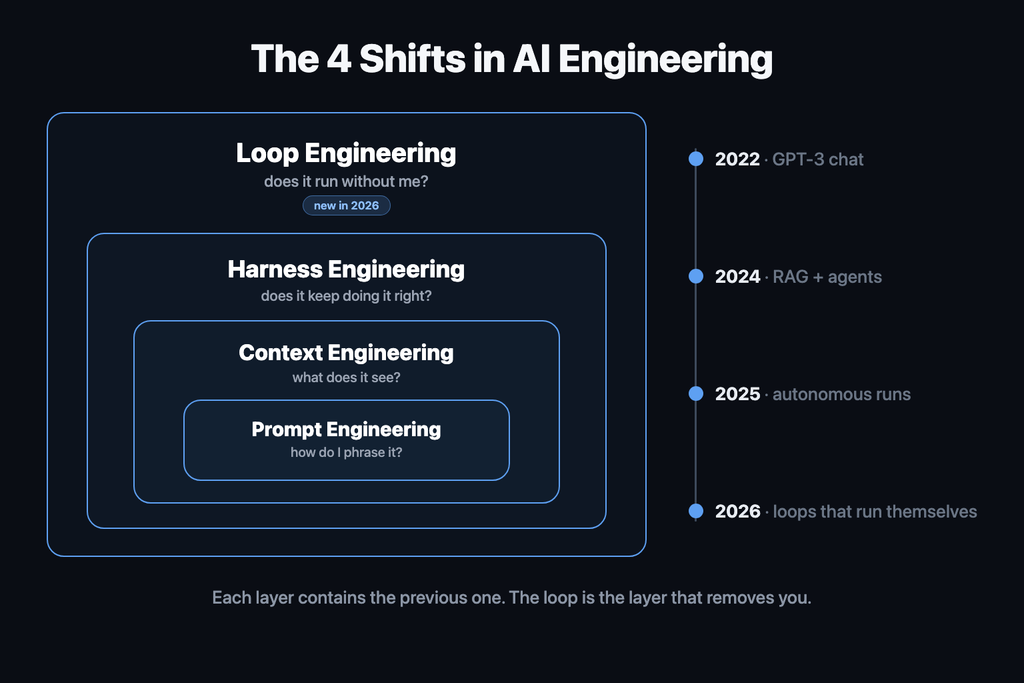
Source: AI Builder Club
Here is what each level looks like applied to localization specifically.
| Level | What happens | Human role |
|---|---|---|
| 1. Basic AI localization | Pure prompt engineering: the model is prompted string by string, or with a batch and a general instruction. Terminology drifts because it has no memory of earlier decisions. | Writes every prompt, reviews every output. |
| 2. Context-aware localization | Glossaries, translation memory, and style guides are manually attached to each request, the hallmark of context engineering. Output is more consistent and high-quality, but limited to what fits in the context window. | Decides what fits into a finite context window. |
| 3. Orchestrated localization | The agent pulls its own glossary and TM entries, writes results back to the right rows, and flags anything that fails a quality check. This is harness engineering at work. | Reviews checkpoints, not every string. |
| 4. Agentic localization | Loop engineering closes the gap. Given a goal, the agent plans the job, gathers context, works through it in chunks, and checks its own output until it is done. It also learns from each job and carries that forward. | Sets the goal and reviews the finished job, rather than every step along the way. |
The build or buy question for agentic localization
This is the distinction that matters most for technically sophisticated teams: is agentic localization something you buy, or something you can build? An in-house pipeline can genuinely reach level 3 or even level 4. The real difference isn’t capability. It comes down to who owns the work of building and maintaining it, and everything that follows from that.
| In-house pipeline | Ready-made agent | |
|---|---|---|
| Who owns the orchestration layer | Your team builds and maintains context assembly, chunking logic, failure handling, output routing, and state management. | The agent owns that layer. It assembles context, manages the loop and chunking, routes output, and handles failures on its own. |
| Time to value | Months to harden a pipeline from a working prototype to something production-ready. | Days. The orchestration layer already exists, so a team is configuring an agent, not building one from scratch. |
| Ongoing engineering | Falls on your team permanently. When model behavior changes or a run fails halfway through, you debug and restart manually. | Handled by the vendor: model updates, new failure modes, and edge cases in chunking or retries. |
| Reliability at scale | A first-generation script has not been tested against every failure mode that matters for translation jobs. | Already tested against common failure modes, such as partial runs, inconsistent terminology across chunks, and context window limits. |
| Reusability | Usually tuned to one use case. A new content type or market often means rebuilding parts of the pipeline. | The same setup applies across projects, languages, and content types without re-engineering. |
| Control and visibility | Full visibility into every step, which some teams need for compliance or highly specialized content types. | Less granular control over the internals, in exchange for not having to maintain them. |
A ready-made agent fits teams without spare engineering capacity, or those localizing across many markets and content types where reusability matters most. An in-house pipeline fits teams with the engineering capacity to own it and a compliance or architecture need a vendor agent can’t meet.
Where most localization teams stand today
Most teams are still at level 1 or 2, even as agentic approaches move from pilot to production elsewhere in the enterprise. Agentic AI adoption across enterprises broadly reached 35% within two years of it becoming a distinct category, with another 44% of organizations planning to deploy it soon (MIT Sloan Management Review & Boston Consulting Group, 2025). Localization is following the same curve, just a step behind: language service integrators report that 84% of their clients requested human editing on AI-generated content in the past year (Slator, 2025), a sign that most AI translation workflows are still treated as a first draft rather than a finished job.
Localization volume is growing faster than headcount at most studios and software companies. Game studios are launching in more markets. Software companies are localizing product, marketing, and support content simultaneously. The teams that scale are not the ones that found a better prompt. They are the ones that stopped treating each string translation as a discrete, human-in-the-loop event. That’s exactly what agentic localization makes possible.
*Gridly is building Localization Agent towards the same idea. Describe what you need in plain language, and the agent pulls the right context, glossaries, translation memory, style guides, project rules, for each string automatically, then runs against your Grid at batch scale. Every instruction stays visible and adjustable, and output can be validated on a sample before a full run, so scaling up doesn’t mean losing sight of what ships. The result is lower localization costs, faster time to market in existing and new languages, and translation quality that holds up at volume, not just on a sample batch.
Learn more about Localization Agent or schedule a demo to see it in action.*
FAQs
What is agentic localization?
Agentic localization is an AI agent that works toward a localization goal, selects its own approach and context, and remembers project state across runs, rather than just responding to a single prompt.
How is agentic localization different from basic AI localization?
Basic AI localization is a prompt in, a translation out, with no memory between runs and no ability to assemble its own context. Agentic localization works toward a goal across an entire job, selects its own context on every string, and remembers project decisions from one run to the next.
Does agentic localization replace human translators?
No. Agents handle context assembly, execution, and self-checking. Human review still matters, particularly for content types where tone, cultural nuance, or brand voice carry the most risk.
What AI localization level should my team target?
It depends on volume and how much of your process is repeatable. Teams with low, occasional translation volume may not need to move past level 2. Teams localizing continuously across many markets, such as live-service games, SaaS products shipping weekly, or enterprises managing product, marketing, and support content at once, get the most value from level 3 or 4.
Author

Quang Pham
Quang has spent the last 5 years as a UX and technical writer, working across both B2C and B2B applications in global markets. His experience translating complex features into clear, user-friendly content has given him a deep appreciation for how localization impacts product success.
When he's not writing, you'll likely find him watching Arsenal matches or cooking.