

Challenges
Constant updates leave no room for delays
Playrix’s four major titles run on a fast, continuous content cycle. New content is shipped every three weeks for each project. Every new feature, event, character, quest, or store update brings new text that needs to be created, translated, checked, and delivered into the game.
The localization team sits in the middle, receiving content from writers and game designers, coordinating translation, and handing finished text back to developers so it can be built into the game. Delays anywhere in that chain block releases.
Spreadsheet handoffs and fragile scripts
Before Gridly, Playrix used Google Sheets to manage text and memoQ for translation work. Frequent content updates required multiple spreadsheet tables, and keeping them in the right structure was problematic for developers when pulling text into their builds.
The localization team had to move content between spreadsheets and memoQ manually, so they built scripts to avoid copy-pasting.
“We had a number of scripts to ease the life of localization project managers. But those scripts required additional technical support. Sometimes they wouldn’t work, sometimes they would do something strange, and we would have to investigate what went wrong and fix it,” recalls Oleg Abasheev, Localization Manager at Playrix.
Separate workflows across game teams
Every major Playrix title ran its own version of this setup. When the Fishdom team hit the limit of what the process could sustain, they were the first to look for something better.
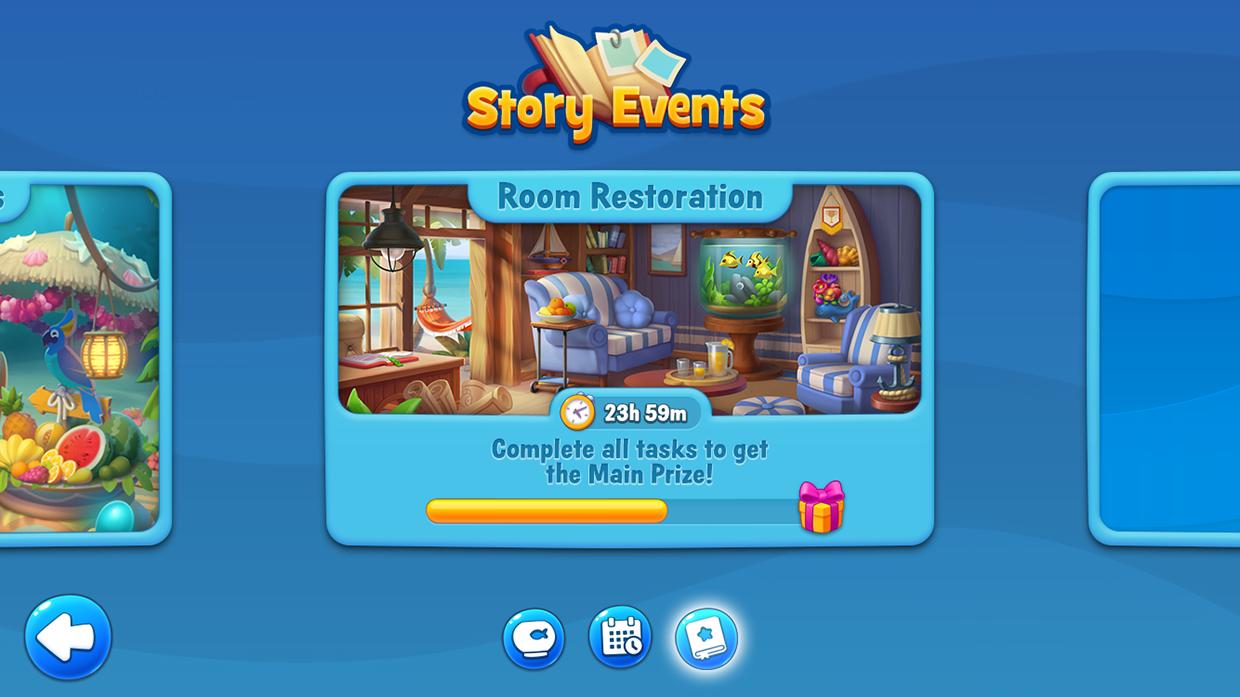 Fishdom regularly introduces fresh live content and in-game events for players.
The solution
Fishdom was the first Playrix team to adopt Gridly. Once it proved its value in Fishdom’s localization workflow, other teams followed.
Today, each title has its own setup in Gridly. This gives Playrix the flexibility to support differences between games, such as the number of languages or specific technical requirements. Yet the structure is similar enough across projects for people to collaborate easily and avoid reinventing the process every time.
Gridly covers the core CMS use case: organizing content, translations, and metadata in one place, tracking updates across languages, and triggering automated workflow steps.
From source text to translated builds without manual handoffs
Writers and game designers put new content into Gridly first, where it’s connected to both development and localization pipelines.
Content lives in Grids, with each team structuring them to fit the way their game is built. Views let teams filter and share specific content: a given release’s strings, everything waiting for translation, or a batch grouped by new features.
“I like that I can combine text for different features in one view. It’s the perfect way for me to prepare content for game designers and localization PMs,” says Galina Rasparkina, Writer for two major titles at Playrix.
The localization team reviews incoming text, runs AI pre-translation, and sends it to memoQ. Translators work in memoQ, and when they’re done, the translated text lands back in Gridly.
“I can click just one button and send text to memoQ, and then again click just one button and receive it back. It’s super, super nice,” adds Anna Afonina, Localization PM at Playrix.
API and memoQ integrations keep systems in sync
Developers use the Gridly API and a clearly defined content structure to move text and translations into their game builds. For memoQ, Playrix uses Gridly’s out-of-the-box integration with a range of settings to fit their translation needs.
Playrix has an in-house AI translation tool for pre-translating text connected with Gridly using webhooks. Localization PMs can trigger these webhooks to fetch pre-translations without any manual work.
Built-in checks help teams catch issues before delivery
Gridly helps localization teams spot when translated text exceeds character limits, making it easier to identify and filter which strings need to be adjusted. This is especially useful for AI translation, where models don’t always follow set limits.
“The cell turns red when character limits have been exceeded. It’s nice to see straight away which text we need to retranslate,” says Oleg.
Built-in checks that detect empty spaces, along with word count statistics, are particularly useful for Galina from the content team.
Localization has become a shared workflow
As Playrix’s use of Gridly grows, more roles have become part of the workflow: programmers, writers, game designers, localization PMs, and even native-language users. Instead of waiting for one person to process a large batch, people can prepare urgent updates themselves and hand them over to localization when ready.
At the same time, the volume of content stored in Gridly grows, and with some titles containing text from many years back, game designers and developers use Gridly as a database to quickly find previously used text for reference.
 Austin from Gardenscapes, one of Playrix’s flagship live games
Results
Playrix now runs a connected localization workflow without the scripts and spreadsheet handoffs that slowed teams down. Content starts in Gridly and moves through AI translation, to translators in memoQ, and back to developers without manual exports, copy-pasting, or scripts that break at inconvenient moments.
130+ hours of manual work saved annually
The team estimates that with Gridly they save around two hours per release cycle for each game, just by automating manual processes. With each of Playrix’s four major titles on a three-week cycle, that adds up to over 130 hours recovered per year.
The broader gain goes beyond the time itself. The scripts failed unpredictably and had to be updated whenever spreadsheets changed. That maintenance burden is now gone as well.
30% faster turnaround in localization updates
Removing manual handoffs and improving visibility has a positive effect on turnaround times. Updates are submitted faster and localization teams need less time to prepare, check, and deliver batches.
This has further positive effects across teams. With a clear overview of content, scope, and progress, teams can plan and execute more efficiently and deliver new content faster.
200+ colleagues collaborating across live game content
The Fishdom team was the first at Playrix to adopt Gridly, starting with 35 users. “They were the trailblazers when it came to using Gridly. Once we saw that it was user-friendly and met our needs, everyone followed suit,” concludes Oleg Abasheev, Localization Manager at Playrix.
Today, more than 200 people across the company collaborate to produce new game content. That growth happened organically as more teams saw Gridly working in practice.