What’s covered
- Technical challenges - why better AI models alone cannot guarantee translation quality at game production scale
- Operational challenges - why AI translation quality at scale depends on structured game localization workflows
- Economic and organizational challenges - why AI translation cost savings are harder to achieve at production scale
- Reducing the work around AI, not only the cost of AI
- FAQs
This piece draws on interviews with Mike Souto and Norbert Szolnoki, covering both the technical reasons AI translation quality breaks down at scale and the operational and economic realities studios face when trying to fix it.
Key takeaway:
A translation can be linguistically good but contextually wrong. It can be linguistically and contextually good but impossible to reproduce reliably across 200,000 strings. And it can achieve production quality but require so much engineering, setup, QA, and post-editing that the economics no longer make sense.
Technical challenges - why better AI models alone cannot guarantee translation quality at game production scale
Key takeaway:
LLMs can produce very strong individual translations while still behaving in ways that make consistent production output difficult. Even advanced LLMs still face context window limits, context rot, probabilistic variation, hallucination, and confident but wrong outputs, while performance can vary across languages and content types. Prompt engineering alone cannot eliminate these behaviors, and simply adding more project context can create new problems when the model has to decide what information matters among thousands of competing inputs. The technical challenge is not finding an AI model that never fails. It is designing a translation process around the ways LLMs actually behave.
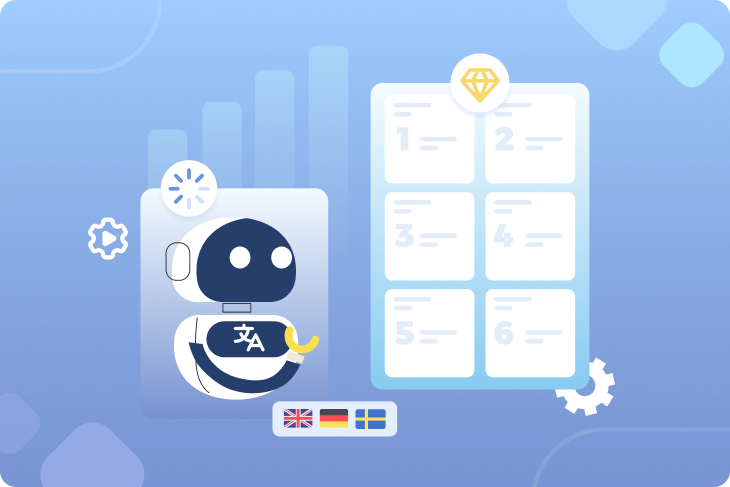
A model may translate one paragraph extremely well, but a game production environment can involve 200,000 strings across 12 languages, different content types, and live-ops deadlines. To explain why good translation capability is different from reliable production behavior, Norbert Szolnoki highlighted six challenges at Game Quality Forum 2026 that are rooted in how LLMs fundamentally work, rather than in the capability of any single model. At game production scale, these characteristics can affect translation consistency, contextual accuracy, and quality across languages.
- Probabilistic generation and non-determinism - LLMs predict likely next tokens rather than retrieve one fixed correct answer. The same input can therefore produce different wording across runs. In game localization, acceptable individual variations can become terminology, tone, or character-voice inconsistencies across thousands of strings.
- Finite context windows - an LLM can only process a limited amount of information at once. Source strings, instructions, glossaries, TM examples, lore, character information, style guides, and other references compete for that capacity. Context rot and imperfect context utilization - even when information technically fits inside the context window, the model does not necessarily use every piece equally or reliably. Adding more context can dilute important instructions or references.
- Hallucination and plausible completion - LLMs are optimized to generate plausible continuations, not inherently to verify every statement against a source of truth. With an ambiguous game string or missing context, a model can infer something that sounds completely natural but is wrong.
- Sensitivity to prompts and context presentation - the model's output can change depending on how instructions are phrased, ordered, formatted, or combined with examples. This means prompt engineering matters, but it also means a prompt that performs well on one content type or language is not automatically reliable across an entire game.
- Uneven performance across languages - model capability is not uniform across language pairs. Training-data availability, linguistic structure, tokenization, and other factors can contribute to different performance levels.
- Limited grounding in project-specific truth - an LLM does not inherently know which translation, terminology decision, character interpretation, or project rule is authoritative for a particular game. Even if it has broad linguistic knowledge, it needs external sources such as approved TMs, glossaries, metadata, lore, and other project assets to establish what is correct for this specific title.
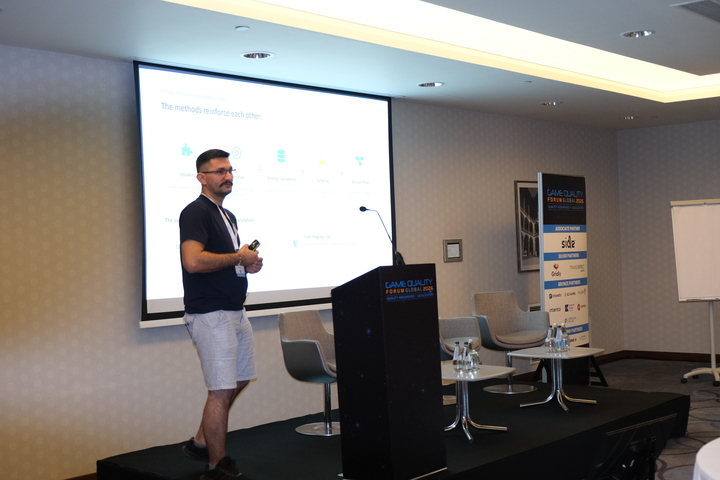
Norbert Szolnoki highlighted six challenges at Game Quality Forum 2026 that are rooted in how LLMs fundamentally work
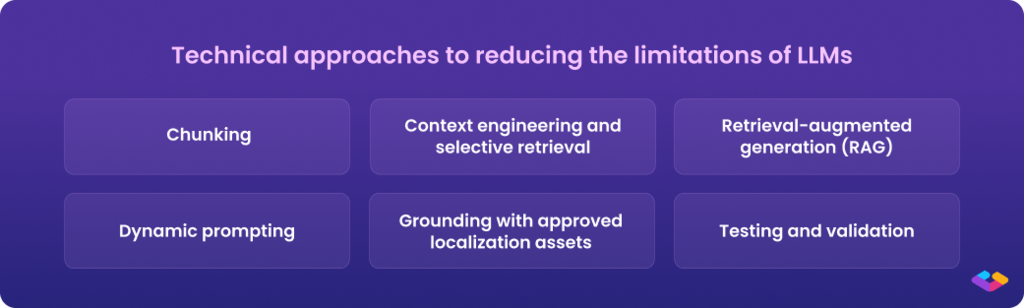
These limitations are not necessarily new to localization professionals working closely with AI. Some teams are already designing around them, while others may first encounter them when moving from small experiments to production volumes. More importantly, none of them means reliable AI translation is impossible. In his talk at the Game Quality Forum 2026, Norbert Szolnoki also shared several established technical approaches for reducing the impact of these limitations:
- Chunking - breaks large volumes of content into smaller, meaningful groups, such as by character, quest, feature, UI area, or content type, so the model can work within its context limits with more relevant information.
- Context engineering and selective retrieval - determines what project information each translation actually needs, rather than loading the same large amount of context into every prompt.
- Retrieval-augmented generation (RAG) - retrieves relevant project knowledge, such as glossary terms, character references, style rules, or approved examples, and provides it to the model when it makes a translation decision.
- Dynamic prompting - adapts instructions and context to the specific string, content type, language, or task instead of applying one static prompt across an entire batch.
- Grounding with approved localization assets - uses existing TMs, glossaries, and approved translations as authoritative references, helping the model follow established terminology and previous localization decisions.
- Testing and validation - evaluates the setup on representative content before applying it to a full production batch, making it possible to identify terminology, context, or language-specific problems before they spread. See how AI-assisted game LQA transforms the industry.
These approaches can address many of the technical limitations of LLMs, but they introduce another challenge: orchestration. For a small test, a localization professional can manually select the right context, adjust a prompt, retrieve approved examples, and review the result. At production scale, the same decisions need to happen repeatedly across thousands of strings, multiple content types, and languages, while the underlying game content continues to change. The technical methods can scale, but manually assembling the data, context, and relationships they depend on cannot. This is where AI translation quality stops being only a model problem and becomes a data and workflow problem.
Operational challenges - why AI translation quality at scale depends on structured game localization workflows
Key takeaway:
Game localization is often treated primarily as a language problem, but at production scale, a string is also a data object. Each string can be connected to characters, scenes, terminology, metadata, translation history, screenshots, versions, languages, and builds - relationships that help determine how it should be translated. When this project knowledge is scattered across spreadsheets, files, tools, or people’s knowledge, assembling the right information for every string becomes difficult to repeat consistently at scale. AI does not remove this operational problem. It can amplify the consequences, allowing decisions based on missing or outdated context to spread across thousands of strings. The operational challenge is therefore not simply giving AI more context. It is building a structured data foundation where the right content, context, and relationships can be reliably connected when AI needs them.
1. Game localization is a data problem as well as a language problem
A game string rarely exists in isolation. Its linguistic meaning can depend on its relationships to other production data - who says it, where it appears, which game feature it belongs to, what terminology has already been approved, or which version and build it belongs to. AI therefore works on a stronger foundation when these relationships are preserved as structured data rather than scattered across loose files and disconnected systems. Structure does not guarantee a correct translation, but it creates the conditions for AI to retrieve and apply project knowledge more reliably.
The production reality, however, is often less structured. Drawing on more than 25 years of working across game production and localization, Michael Souto describes a recurring pattern: content, context, decisions, and supporting information become fragmented as they move between people, tools, files, and stages of production. The problem existed long before generative AI, but AI makes the underlying structure more consequential because translation decisions can now be made at much greater speed and volume.
This creates an important distinction for AI translation quality: having context is not the same as being able to operationalize it. The necessary project knowledge may exist somewhere, but at production scale it needs to be found, connected to the right content, and supplied at the right moment. The operational question is therefore not only whether AI can understand the words, but whether the localization workflow can reliably preserve and use what those words are connected to.
2. Manual context assembly does not scale with game production
For a handful of ambiguous strings, fragmentation can be manageable. A localization professional can find the relevant terminology, previous translations, character information, or visual references, assemble the right context, adjust the instructions, and review the result. The problem appears when the same process has to happen repeatedly across thousands of strings and multiple languages.
This is where the technical approaches discussed earlier meet production reality. Context engineering, RAG, dynamic prompting, and grounding can help address LLM limitations, but they all depend on identifying and supplying the right information for the right content. At production scale, context therefore needs to move from something people manually search for and assemble to something the workflow can reliably retrieve and connect.
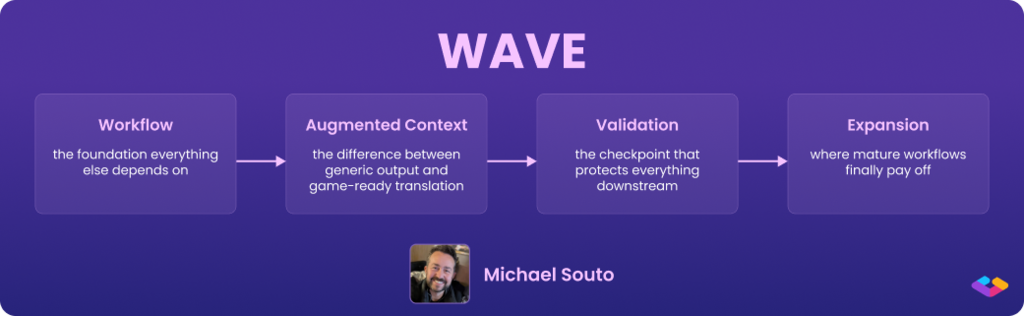
Michael Souto explored this problem in the June 2026 edition of MultiLingual through a framework he calls WAVE - Workflow, Augmented Context, Validation, and Expansion. Its order is intentional. Workflow comes before Augmented Context because dynamically supplying AI with the right project knowledge depends first on having content, context, and relationships that can be reliably accessed and connected.
3. AI scales the structure underneath it
AI does not inherently fix the weaknesses of an existing localization workflow. It can be more useful to think of it as an amplifier. If project knowledge is fragmented, outdated, or poorly connected, AI can apply decisions based on those weaknesses across much larger volumes of content. If the underlying content and relationships are well structured, the same speed can instead support more reliable retrieval of context, established terminology, and validation.
This is why structured data matters beyond simply storing localization content in one place. RAG needs reliable information to retrieve. Dynamic prompting needs structured signals to determine which instructions and context apply. Validation needs trusted references against which new output can be checked. The technical methods discussed earlier can operate at scale, but their reliability depends on the data and relationships underneath them.
Michael describes the opposite scenario as “faster chaos”: AI increases throughput without resolving the workflow weaknesses that already existed. His WAVE framework therefore puts Expansion last, after Workflow, Augmented Context, and Validation. The goal is not simply to make translation faster, but to establish the conditions under which that speed can be used reliably at production scale.
A structured localization workflow can make context retrieval, dynamic prompting, validation, and automation more manageable at production scale. But that raises another question: who designs, operates, and maintains this system, and what happens to the expected AI translation savings once that work is included?
Economic and organizational challenges - why AI translation cost savings are harder to achieve at production scale
Key takeaway:
AI translation can reduce the cost of generating a first translation, but generation is only one part of making AI work in game production. The technical and operational challenges discussed earlier still need to be solved, which means someone has to design the workflow, configure prompts and context, connect project knowledge, validate outputs, and maintain the setup as the game changes. For in-house localization teams, this work comes alongside demanding production schedules and often requires knowledge that crosses localization, AI, data, and engineering. The organizational challenge is therefore not simply whether a studio has access to capable AI models, but whether it has the time, expertise, and technical resources to turn those models into a reliable localization workflow at scale. The economic question follows: if significant internal effort is required to make AI production-ready, how much of the expected cost saving remains?
1. Localization teams have limited capacity to take on another technical discipline
Looking back over more than 25 years in game production and localization, Mike Souto describes an industry where technology has continued to improve while localization production has become increasingly complex. Better tools and more connected production pipelines have changed what teams can accomplish, but localization still operates within changing content, multiple languages, production dependencies, and demanding delivery schedules.
AI arrives within this existing production reality. Localization teams are being asked to explore a technology that could reduce translation effort while simultaneously managing the workload that makes greater automation attractive in the first place. Learning how to use an LLM is one thing. Finding the time to design, test, and continuously manage an AI translation workflow alongside ongoing production is another.
The question is therefore not whether localization professionals are capable of working with AI. It is how much additional technical responsibility can realistically become part of the localization function without creating another operational burden.
2. Someone still has to build and operate the AI translation workflow
The previous sections show what sits behind reliable AI translation at scale. Chunking, context engineering, RAG, dynamic prompting, structured content relationships, approved localization assets, validation, and workflow safeguards do not come together automatically simply because a studio has access to an advanced LLM.
Someone has to decide how these components should work together for a particular game, connect them to the production pipeline, test their behavior, and maintain the setup as content and requirements change. This can require knowledge spanning localization, AI, data, and engineering rather than expertise that traditionally sits within one role.
This creates an ownership question. A studio may choose to build the orchestration internally, drawing on localization and engineering resources. For teams with the necessary expertise, infrastructure, and capacity, that may make sense. But doing so also means owning the prompts, retrieval systems, workflow logic, integrations, QA rules, monitoring, and ongoing maintenance around the model. Gridly’s Localization Agent materials identify these as significant parts of a client-run LLM architecture.
The question is therefore no longer simply “Can the studio use AI for translation?" It becomes “Who should own the work required to make AI translation reliable at production scale?"
3. The cost of AI translation is more than the cost of generation
Once that organizational effort is included, the economics of AI translation also look different. Model or API costs can make generating translations appear inexpensive, but they represent only one part of producing localization that is ready to ship.
The time spent designing and maintaining the workflow, involving engineering resources, preparing context, testing configurations, validating results, reviewing output, and correcting failures also carries a cost. Norbert Szolnoki describes one version of this problem at Game Quality Forum as “the math that never works”: when enough setup and cleanup are required to make AI output acceptable, some of the expected savings can disappear.
This does not mean AI translation cannot reduce localization costs. It changes what needs to be measured. Rather than comparing the cost of AI-generated words with traditional translation rates alone, the more useful comparison is the total effort required to produce translation that is reliable enough for production.
In other words, AI may reduce the work of producing a translation while introducing new work around making that translation reliable at scale. For game studios, the economic question is therefore not only how cheaply an AI model can translate, but how much work the organization has to do before that translation can be trusted in production.
Want the full picture of how AI translation fits into game localization? Read AI translation in game localization: the complete guide.
Reducing the work around AI, not only the cost of AI
The alternative to building and maintaining this orchestration layer internally is to make more of it part of the localization system itself. This reflects a broader shift toward agentic localization, where AI agents handle more of the context-gathering and orchestration work that used to fall on localization teams. This is the problem Gridly is approaching with Localization Agent - project-specific AI translation and QA designed to operate at production scale without requiring localization teams to manually assemble the context and technical workflow around every translation task.
Localization Agent sits on Gridly’s structured content foundation, where strings and project knowledge can remain connected. It can use that structure to assemble project-specific context, generate plain-language instructions for translation and QA tasks, process content in large batches, and keep those instructions visible and adjustable so teams can validate how the workflow behaves before scaling it further.
The goal is not to remove localization expertise from the process, but to reduce how much of that expertise has to be spent manually orchestrating AI. For game studios evaluating AI translation, that may be the more useful economic question: not only how much translation AI can produce, but how much work the organization has to do before that translation can be trusted at scale.
Find out more about Localization Agent or schedule a demo.
About Michael Souto
Spent over a decade as a video game producer before moving into localization technology, Michael Souto has worked on both sides of the table, inside development studios and alongside the tools teams use to manage multilingual content at scale. Today he is Director of Business Development at Gridly, where he works closely with game studios on the operational realities of localization.
About Norbert Szolnoki
As a Senior Solutions Engineer at Gridly and a PhD candidate researching AI-assisted vulnerability detection, Norbert approaches AI from two complementary perspectives: understanding how AI systems behave under real-world conditions, and helping localization teams apply them in production.
FAQs
Why does AI translation quality break down at production scale? A translation can be linguistically good but contextually wrong, or good on both counts but impossible to reproduce consistently across thousands of strings. Quality at scale depends on more than translation capability. It depends on a repeatable process built around how LLMs actually behave.
Why do AI translations sometimes sound right but are actually wrong? LLMs are built to generate plausible continuations, not to check every statement against a source of truth. Given an ambiguous string or missing context, a model can produce something that reads naturally but doesn’t match what the game actually needs.
Can better AI models alone fix translation consistency problems? No. Even advanced models still face context window limits, context rot, and uneven performance across languages. A prompt that works well for one content type or language isn’t automatically reliable across an entire game, so the fix has to be structural, not just a better model or prompt.
Does AI translation actually reduce localization costs? It can lower the cost of generating a first translation, but generation is only one part of production-ready localization. Designing the workflow, preparing context, validating output, and maintaining the setup all carry a cost, and that work is what determines how much of the expected saving actually remains.
Who should own an AI translation workflow, localization or engineering? Making AI production-ready typically requires knowledge across localization, AI, data, and engineering rather than one role. Studios can build this internally if they have the capacity, but it means owning the prompts, retrieval systems, and ongoing maintenance alongside existing production schedules.