What’s covered
- What actually drives post-editing cost in game localization?
- Solution 1: Raise AI-translation quality from the start
- Solution 2: Use AI-generated confidence scores to route review
- Solution 3: Translate from the closest existing variant, not from the source language, every time
- How can game localization teams start reducing post-editing cost?
- How Gridly’s Localization Agent helps you save on post-editing cost
- Frequently asked questions
Post-editing is where most of the money in AI game localization actually goes. The translation itself is cheap. The linguist hours spent fixing, checking, and re-checking machine-translated strings before they ship are what erode the savings teams expected when they adopted AI translation in the first place.
There are three real levers for reducing post-editing cost, and all three work by changing what a human has to touch, not by removing the human. The first is getting AI-translation quality higher before a linguist ever opens the file, so there’s simply less to fix. The second is using AI to generate a confidence score for each translated string, so review time goes to the strings that actually need it instead of everything. The third, specific to games shipping multiple language variants, is translating into the variant AI already handles well and adapting from there, instead of asking AI to translate directly from the same source language into every variant, including the ones it’s weaker at.
This post covers all three, plus where they show up in a live-service or ongoing game localization pipeline.
What actually drives post-editing cost in game localization?
Post-editing cost is driven by two independent factors: how much of the AI translation output needs correcting, and how much of it gets reviewed regardless of whether it needs correcting. Most localization teams only try to control the second factor, reviewing everything at the same depth no matter how the engine performed on any given string.
Game content makes this worse than most localization work. Short UI strings, recurring item and character names, and context-poor dialogue lines are exactly the content types where generic AI translation drifts and inconsistency creeps in, which pushes more strings into the “needs a human” pile than a better-prepared engine would produce.
That gap shows up in how enterprise game studios are actually using AI today. In a live poll during a recent webinar on AI localization in games, attendees were asked where they actually use AI in their localization work. First-pass translation of new content led by a wide margin at 29%, while every other use case trailed well behind: automated QA checks at 16%, checking source text before translation at 13%, quality review or scoring at 12%, and adapting between regional variants at just 4%.
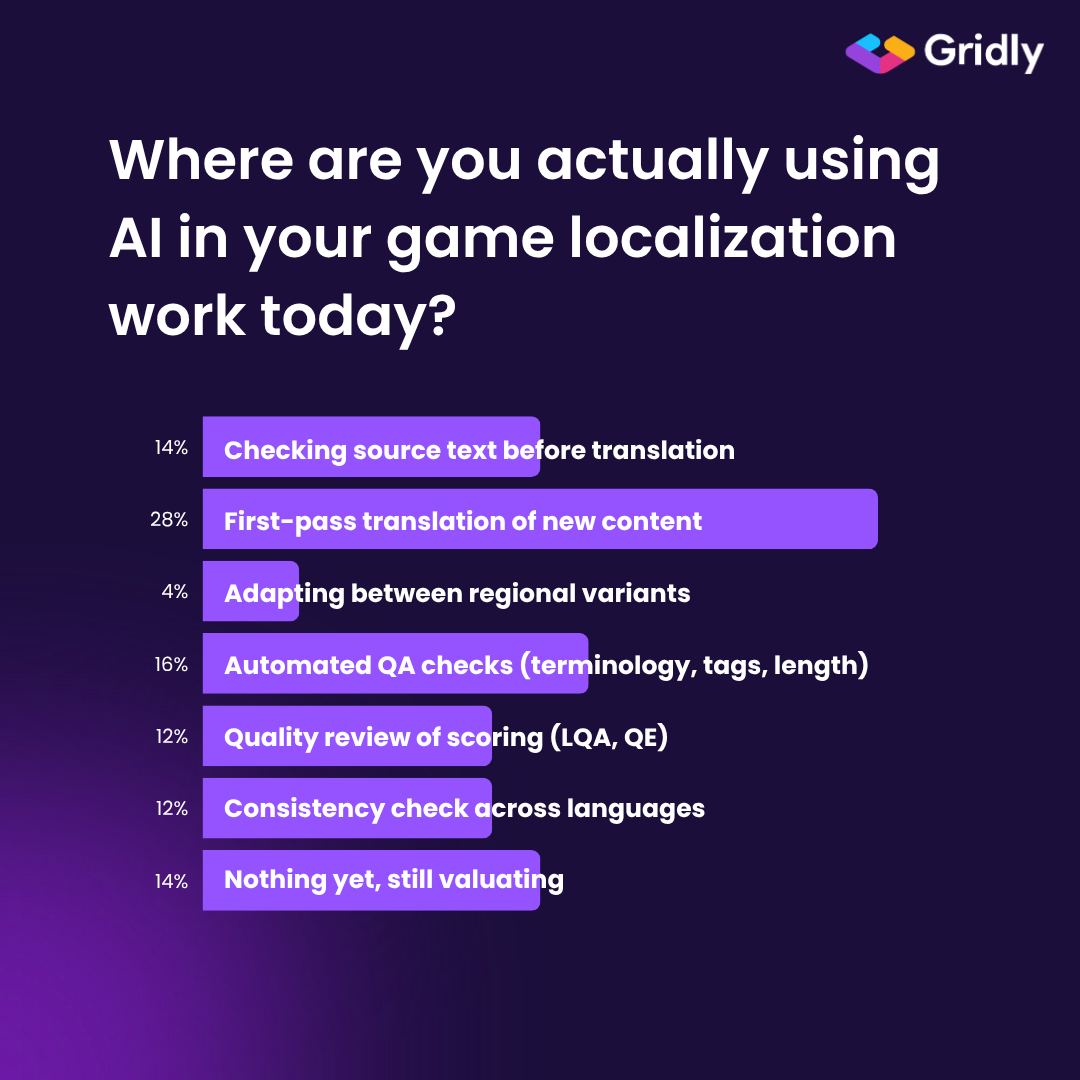
In other words, most studios have gotten comfortable with the one AI use case that does the least on its own to reduce post-editing cost, first-pass translation, while the three that actually shrink post-editing volume, cleaner input, AI-assisted quality checks, and variant adaptation, are still catching on. That’s the opportunity the rest of this post digs into.
Solution 1: Raise AI-translation quality from the start
The fewer errors an AI translation engine makes on the first pass, the less post-editing volume there is to pay for. This sounds obvious, but most teams treat translation quality and review cost as separate problems, when quality is the upstream lever that determines how much review is even needed.
The clearest way to raise first-pass quality is fixing what feeds the engine, not switching engines. Six levers make the biggest difference:
- Cleaning up source text before it ever reaches the model.
- Giving strings context (screenshots, descriptions, character limits) so the model isn't translating in a vacuum.
- Building translation memory and glossaries so recurring terms and phrases don't get reinvented every job.
- Writing better prompts (role, context, examples).
- Adding an AI quality review layer before human review.
- Treating post-editing corrections as feedback that updates the glossary and TM for the next batch.
See Gridly’s full guide on how to improve AI translation quality for a deeper breakdown of each lever.
For games, that plays out concretely: character and item names stay consistent across every string instead of a linguist catching three different translations for the same sword in post-editing, recurring UI and system strings get reused from translation memory rather than re-translated and re-checked every patch, and tone holds steady across dialogue when a glossary encodes character voice or world-specific terms up front.
Although none of this eliminates post-editing completely, it shrinks the pool of strings that need it.
Solution 2: Use AI-generated confidence scores to route review
A confidence score reduces cost because it tells a reviewer which strings need attention before they open a single file, instead of finding out by reading everything.
This is the other side of the equation: even a well-prepared engine still produces some strings that need a human, and confidence scoring is what routes review effort to those strings specifically. AI translation generates the output, a scoring step estimates how reliable each string is, and only the segments below a set threshold go to a linguist. High-confidence strings move straight to the build.
The evidence for this is strongest in academic research rather than vendor claims. A 2021 study from the Association for Computational Linguistics tested a post-editing interface that combined sentence-level and word-level quality estimation with translation suggestions. Post-editors using the quality-estimation-assisted interface completed translations 52.9% faster than translating from scratch, while output quality also improved. The mechanism wasn’t a better translation engine. It was better routing of human attention.
Here’s how a full-review workflow compares with a confidence-score-based one at the same content volume.
| Factor | Full review (every string) | Confidence-score-based review |
|---|---|---|
| Reviewer workload | 100% of translated volume. | Typically the lowest-confidence 20 to 30% of volume. |
| Turnaround time | Scales linearly with string count. | Scales with flagged volume, not total volume. |
| Cost per string | Fixed, regardless of AI translation quality. | Falls as engine quality and coverage improve over time. |
| Best fit | Legal text, EULAs, store compliance copy. | In-game UI strings, patch notes, recurring dialogue. |
| Risk if misapplied | Low risk, high cost. | Low cost, but risky without a reliable scoring step. |
Full review is best for content where a mistranslation carries legal or compliance risk, such as EULAs or platform store copy, while confidence-score-based review works better for high-volume, lower-risk content such as UI strings and patch notes, where speed and language coverage matter more than perfect polish on every line.
Solution 3: Translate from the closest existing variant, not from the source language, every time
Post-editing cost is higher than it needs to be when AI translates directly from the source language into every language variant, instead of adapting from a variant it’s already translated well. Games rarely ship to a single flavor of a language. Regional variants such as en-US and en-GB, pt-BR and pt-PT, zh-CN and zh-TW, or Malay and Indonesian share the bulk of their vocabulary and grammar and differ mainly in spelling, terminology, currency, and cultural references.
Generic AI translation doesn’t treat all variants equally. Google Research’s FRMT benchmark found that machine translation models with no region-specific signal default to whichever variant dominates their training data, producing a 20.6 BLEU-point quality gap between Brazilian and European Portuguese output when translating directly from the source language. In practice, that means translating the source language into the underrepresented variant is the AI’s weakest path and needs the most correction, while translating the source language into the dominant variant is comparatively its strongest.
The fix flips the order of operations: translate the source language into the variant the AI already handles well, then adapt that reviewed output into the closely related sibling variant. The study also found that supplying the model with even a handful of examples from the target variant meaningfully closed the quality gap, without retraining. Adapting from an existing, correct translation in a linguistically close variant gives the AI a much narrower job, matching vocabulary and spelling conventions, than solving the full translation problem from the source language in a direction it’s already weaker at. A narrower job means less for a human to fix afterward.
For a live-service game adding regional storefronts or expanding into new Chinese or Spanish-speaking markets over time, this compounds with every content update, since the alternative is repeatedly asking AI to translate into its weaker path from scratch. Learn more about live-service game localization.
How can game localization teams start reducing post-editing cost?
Combining all three levers works better than picking one. A workable order:
- Build or import translation memory and a glossary for recurring game content (character names, item names, UI strings) before scaling up AI translation volume, so the engine has less to get wrong from the start.
- Set a conservative confidence threshold on the AI translation output, and tighten it only after several cycles of agreement between the AI's confidence score and a human reviewer's judgment.
- Translate the source language into the variant your engine already handles well, then adapt that reviewed output into linguistically close sibling variants instead of translating each one directly from the source language.
- Keep full human review on legal, compliance, and store-listing content no matter how well the engine performs on in-game strings.
- Reinvest the post-editing hours this frees up into more languages or a deeper creative pass on flagship content, rather than treating the savings purely as headcount reduction.
- Revisit the confidence threshold every content update or season. Engine quality and content mix both drift over a live-service game's lifecycle.
How Gridly’s Localization Agent helps you save on post-editing cost
Gridly’s Localization Agent. Localization Agent is an AI agent built into Gridly’s localization platform, designed for teams that want AI to handle repeatable localization tasks without losing sight of what it’s doing. It’s not a single translation button. Depending on what a project needs, it can be used for translation, cross-language quality checks, language variant adaptation, or documentation of what was changed and why, all visible to the team before anything ships.
Localization Agent maps directly onto all three levers above. Working with a project’s existing translation memory, glossary, and other translation resources instead of translating in isolation drives higher translation quality and better LQA accuracy on content a team has already localized before, which addresses the first lever. Cross-language quality checks surface which strings need a closer look, giving reviewers a place to start instead of reading every line, which handles the second. And its language variant adaptation capability takes a reviewed base translation and adapts it into related regional variants, so post-editing only has to cover what’s actually different about a locale rather than the content it shares with every other variant, closing out the third.
Localization Agent is built to be tested on a sample batch before it runs on a full project, with instructions you can read and adjust rather than a black box you have to trust outright. It’s a step toward agentic localization, built for teams that want AI handling more of the repeatable work while keeping a clear view of the pipeline.
Learn more about Localization Agent or book a demo to see how it works.
Frequently asked questions
Does AI eliminate the need for post-editing in game localization?
No. AI still needs some human review, especially on legal, compliance, or brand-critical strings. What changes is how much content needs review and how targeted that review is, not whether review is needed at all.
What’s the most effective way to reduce post-editing costs in AI game localization?
Combining approaches works better than relying on one. Raising AI-translation quality upfront shrinks the pool of strings that need a human. AI-generated confidence scores route review time to the strings that actually need it. Adapting a reviewed translation into a closely related variant, instead of translating into that variant from the source language every time, avoids the AI’s weakest translation path and needs less correction.
How much time does AI quality estimation save during post-editing?
Academic results vary by language pair and content type, but a 2021 study from the Association for Computational Linguistics found a 52.9% reduction in translation time when post-editors used a quality-estimation-assisted interface compared with translating from scratch. Real-world savings depend on how well-calibrated the confidence threshold is for the content being reviewed.
What game localization content should always get full human review?
Legal terms, platform store compliance copy, and EULAs. The cost of an error there is higher than any post-editing time saved elsewhere.
Author

Quang Pham
Quang has spent the last 5 years as a UX and technical writer, working across both B2C and B2B applications in global markets. His experience translating complex features into clear, user-friendly content has given him a deep appreciation for how localization impacts product success.
When he's not writing, you'll likely find him watching Arsenal matches or cooking.