What’s covered
- Why the traditional game growth playbook is changing
- Why game localization strategy matters for market expansion
- Why AI game localization needs more than a powerful LLM
- How a Localization Agent supports game localization workflows
- Building a scalable game localization strategy for 2027
For years, a familiar growth strategy was to develop a promising game, launch it, invest in user acquisition, and focus on established gaming markets. But as competition intensifies, studios may need to reconsider where their next phase of growth will come from.
One opportunity lies in existing franchises. Expanding into new markets, reaching new player communities, and delivering more frequent live content can create additional value from games that already have an audience. During Gridly’s webinar introducing its Localization Agent, Jörgen Larsson, former CEO of Stillfront Group, discussed localization as a potential growth lever. Anna Albinsson and Michael Souto explored how AI game localization can support increasingly complex multilingual workflows.
Why the traditional game growth playbook is changing
Over more than 25 years in the gaming industry, Jörgen Larsson, founder and former CEO of Stillfront Group and now a Gridly board member, has witnessed the industry evolve through multiple cycles of growth, disruption, and technological change.
Jörgen Larsson reflected on how the formula for growing a successful game company has changed: In the past, the approach was relatively straightforward. A studio could develop a reasonably good game, launch it on Steam or mobile platforms, invest in user acquisition through channels such as Facebook and Google, and primarily target established Tier 1 markets. This combination could generate substantial growth without necessarily requiring an exceptional game.
According to Jörgen, that approach has become much less effective over the past few years.
Instead, he sees greater opportunities in making better use of products and franchises that already have an established audience. For studios with successful titles, growth does not necessarily require starting from scratch with another game. It can come from extending the reach and lifespan of existing ones.
Jörgen Larsson highlighted two areas in particular.
- The first is expanding the audience for existing franchises. A game that has already established a player base in one market may still have untapped potential in other regions. Reaching those audiences offers studios another way to grow without relying entirely on new game launches.
- The second is increasing the pace of live operations and downloadable content. More frequent updates, events, and additional content give existing players more reasons to return, spend time in the game, and potentially increase their spending.
These two approaches reinforce each other. A game that continuously evolves can maintain its relevance among existing players while also creating opportunities to attract audiences in new markets.
Jörgen’s observation suggests a shift in how studios might approach growth in 2027. Rather than focusing exclusively on the next successful launch, they may need to consider how much potential remains in the games they have already built.
Why game localization strategy matters for market expansion
If existing franchises represent one opportunity for growth, the next question is where studios can find new audiences. Drawing on his experience in the gaming industry, Jörgen pointed to a significant change in the geographic distribution of growth.
Historically, many Western game companies concentrated their expansion efforts on established markets, particularly North America and other Tier 1 countries. These markets remain commercially important, but their maturity also means that growth opportunities may be more limited than in faster-growing regions.
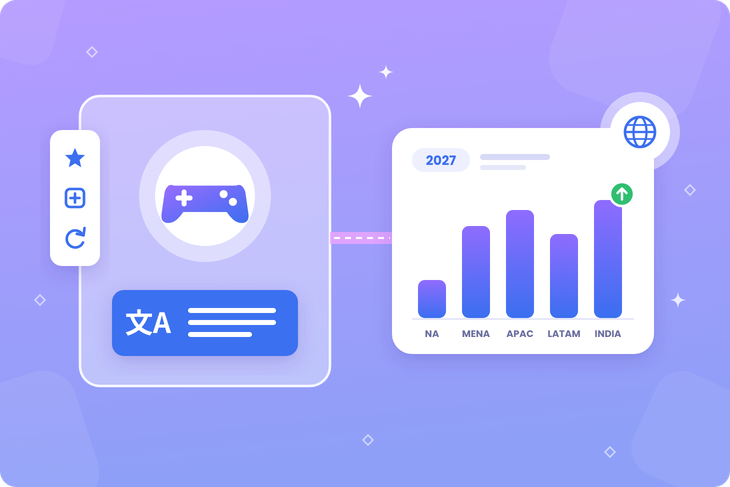
During the Introducing: The Localization Agent webinar, Jörgen presented regional market data showing comparatively modest growth in North America, while highlighting stronger growth potential in the Middle East and North Africa (MENA), Asia-Pacific, Latin America, and India.
Jörgen Larsson noted that many Western game companies have yet to fully introduce their major franchises to some of these markets. This presents an interesting opportunity. Rather than developing entirely new products for every region, studios may be able to reach additional audiences by making existing games accessible and relevant to local players.
However, geographic expansion involves more than making a game available in another country: Different markets bring different languages, cultural expectations, player preferences, and platform requirements. What works for an established audience in North America or Europe may not necessarily resonate with players elsewhere.
This is where Jörgen sees the role of localization changing: Localization is no longer simply a production cost to be minimized. It can become a strategic capability that enables market expansion. For studios pursuing international growth, a game localization strategy needs to consider not only which languages to support, but also how to adapt the experience for different audiences and maintain that experience as the game evolves.
This is particularly important for live-service games. Entering a new market is not a one-time translation project. New events, characters, updates, and downloadable content must continue to reach players in their languages throughout the game’s lifecycle. As studios expand into additional markets while increasing the frequency of content releases, localization workloads can grow considerably.
That creates a new operational challenge: how can studios support more languages, more content, and faster updates without allowing localization costs and complexity to grow at the same rate? This is where AI game localization becomes relevant, not simply as a way to translate content faster, but as part of a broader approach to managing multilingual content at scale.
Why AI game localization needs more than a powerful LLM
Consider a live-service game introducing new characters, quests, interface updates, and seasonal events across multiple languages. Each update brings new content to translate, review, and maintain, often within tight release schedules.
Large language models can produce fluent translations, but linguistic accuracy alone does not guarantee that a translation will work in a game. A dialogue string may depend on the character speaking or the surrounding scene. A controller instruction may require platform-specific terminology, while an interface string must fit within technical constraints.
As discussed in Why AI Translation Quality Breaks Down at Scale, these challenges cannot be addressed through model capability alone. Reliable AI game localization also depends on how contextual information, instructions, and quality assurance are managed throughout the workflow.
This is where a game localization management platform becomes relevant. By keeping source content, translations, terminology, and project knowledge connected, it provides the foundation for AI systems to access relevant information during translation and QA.
Building on this foundation, agentic localization introduces a more coordinated approach, where AI agents can retrieve context, process content, and support validation across different localization tasks.
The practical question is how these capabilities work together in a production workflow. During Gridly’s webinar introducing the Localization Agent, Michael Souto demonstrated three examples using the Localization Agent, from identifying source-text issues to context-aware translation and quality assurance.
How a Localization Agent supports game localization workflows
The three examples illustrate potential roles for AI before, during, and after translation, rather than treating AI as a standalone text-generation tool.
1. Identifying source-text issues before translation
One of the challenges in game localization is that translation quality depends partly on the quality of the original content. A source string may appear straightforward to its writer but contain ambiguities, inconsistent terminology, or technical errors that become more problematic when translated into multiple languages.
This is particularly relevant for games, where individual strings are often managed separately from the scenes, characters, or gameplay situations in which they appear. Without sufficient context, even an experienced translator may struggle to determine the intended meaning.
During the webinar, Mike Souto demonstrated how Gridly’s Localization Agent could identify these issues before translation began. Using a sample dataset of 17 game strings, the agent analyzed source content alongside contextual information stored in Gridly, including glossary terms, character details, record identifiers, and text-length constraints.
The analysis revealed several types of potential problems. Expressions such as “blow up,” “easy as pie,” and “blow me down” were flagged because their meanings could depend on the surrounding context. The agent also identified missing punctuation, unclosed markup tags, and strings exceeding specified length limits.
A particularly interesting example involved platform-specific terminology. When an Xbox-specific button term appeared in a PlayStation record, the agent used information from the glossary and record identifier to recognize the inconsistency. This is the kind of issue that may be difficult to identify through linguistic analysis alone, because the wording itself is not necessarily incorrect. The problem emerges only when the text is considered alongside its intended platform.
Rather than simply producing a list of errors, the agent generated explanations, severity classifications, and suggested corrections. These findings were then mapped back into Gridly, where records could be filtered according to whether they contained major issues, minor issues, or no detected problems.
The demonstration illustrated how AI can support localization before any translation takes place. Identifying potential source-text issues early gives teams an opportunity to clarify meaning, correct technical errors, and resolve terminology inconsistencies before those problems spread across multiple languages.
This becomes increasingly relevant as studios expand into additional markets. A source-text issue that affects one language today could require corrections across many localized versions later. Improving the quality of source content can therefore help reduce avoidable rework throughout the localization process.
2. Applying contextual rules during translation
Once the source content has been prepared, the next challenge is ensuring that translations reflect the game’s intended meaning, style, and terminology. This is where AI game localization becomes more complicated than simply converting text from one language into another.
A character’s dialogue, for example, may need to follow a particular speaking style. Certain names may have approved localized equivalents, while interface instructions must remain consistent with the platform on which the game is played. These requirements can vary not only between games, but also between individual characters and target languages.
In the second part of the demonstration, Mike showed how the Localization Agent used project knowledge and contextual information during English-to-Spanish translation.
One example involved a character named Tim, whose dialogue was configured to appear entirely in uppercase in Spanish to reflect his shouting style. When processing Tim’s dialogue, the agent applied this instruction without treating it as a universal rule for other characters or languages.
The distinction is important. A localization rule may be appropriate for one character in one language but unnecessary or even incorrect elsewhere. Applying such rules consistently requires the translation process to understand which instructions are relevant to each string.
Another example involved character-name localization. The project’s glossary specified that the name Dave should be translated as Leo in Spanish. By incorporating this information into the translation process, the agent could follow the established naming convention rather than independently deciding how to handle the name.
The demonstration also returned to platform terminology. When a source string contained a potential inconsistency between the button name and the platform indicated by the record, the agent could flag the issue for review rather than silently assuming which information was correct.
Behind these examples is a broader technical approach known as context orchestration.
Instead of sending a large collection of strings to an LLM with a single generic instruction, the Localization Agent analyzes the available content, divides it into smaller chunks, and assembles relevant contextual information for each processing task. Mike explained that these chunks can then be processed in parallel, allowing the system to handle larger volumes of content while keeping the instructions focused.
For game studios, this approach addresses a practical challenge. As a game expands into more languages, localization teams must maintain consistency across an increasing number of translations, characters, and content updates.
The ability to reuse established project knowledge and apply relevant instructions during translation can reduce the need to repeatedly communicate the same requirements. It can also help teams manage multilingual content more consistently as production scales.
However, applying contextual rules during translation is only one part of maintaining quality. Even when an AI system has access to relevant project information, its output still needs to be evaluated for errors, omissions, and inconsistencies.
That brings quality assurance into the same workflow.
3. Prioritizing translation QA and human review
As game studios introduce more languages and increase the frequency of content updates, translation quality assurance becomes an increasingly demanding part of localization management.
Every new batch of content may contain terminology inconsistencies, incorrect interpretations, formatting problems, or errors introduced during translation. Reviewing these issues across multiple languages requires time and coordination, particularly when teams are working toward frequent release deadlines.
In the final part of the demonstration, Mike showed how the Localization Agent could evaluate existing Spanish translations and identify potential quality issues.
The agent analyzed the translations against their English source content and available project context, then generated findings that included severity levels, explanations, and suggested corrections.
One example involved a translation that failed to preserve the intended meaning of a sentence about blowing up zombies. Although the translation existed in the project, the agent identified the discrepancy and proposed a corrected version.
Another example concerned a placeholder error that Mike had deliberately introduced by removing the letter “s” from a placeholder containing “cross.” The agent detected the mismatch and suggested a correction.
These examples demonstrated that the QA process was not limited to translations generated by the Localization Agent itself. It could also examine existing translated content, making it potentially useful for identifying problems in material produced through other workflows.
The agent also identified platform terminology inconsistencies, similar to those detected during the source-text QA stage. This reinforced the importance of maintaining contextual information throughout the localization process, rather than treating source preparation, translation, and QA as entirely separate activities.
Once the analysis was complete, Mike pushed the findings back into Gridly and opened a dedicated Spanish QA view. This brought together the English source, Spanish translation, character information, issue severity, explanations, and suggested corrections.
Instead of manually searching through every record, reviewers could filter the view to focus on strings flagged with major or minor issues. They could then compare the existing translation with the proposed correction and decide whether to accept it or provide an alternative.
This illustrates how AI-assisted QA can help teams organize and prioritize review work.
It does not eliminate the need for human judgment. AI-generated findings may contain false positives or overlook genuine errors, and some translation decisions depend on creative or cultural considerations that cannot be resolved through automated checks alone.
Nevertheless, making potential issues visible and actionable within a localization management platform can help teams allocate their review effort more effectively.
Taken together, the three demonstrations show how a Localization Agent can support a connected process, from identifying problems in source content to applying contextual knowledge during translation and evaluating the resulting output.
For studios looking to expand existing games into additional markets, the significance goes beyond individual translation tasks. The larger challenge is maintaining quality and consistency while managing more languages, more frequent updates, and growing volumes of content.
AI localization workflows can help address parts of that challenge, provided they are supported by reliable project information, appropriate quality controls, and human oversight.
Building a scalable game localization strategy for 2027
There is no single growth strategy for every studio. Some will prioritize new intellectual property; others may find opportunities in established franchises, player retention, or new markets. Before expanding, studios should consider which existing titles have demand in additional regions, whether their localization operations can handle more languages and updates, and whether they evaluate localization as both a cost and an enabler of growth.
AI can contribute when it reduces operational friction without introducing unacceptable quality risks. The objective is not merely to translate more strings, but to support more markets and content changes reliably.
For studios with established franchises, growth may come from reaching new audiences and extending the life of existing games. As AI accelerates content production, the infrastructure supporting multilingual content becomes increasingly important. The question for 2027 is not only how studios can create more content or translate it at lower cost, but whether their content operations can support the languages, markets, and player experiences they want to reach.
The perspectives shared in this article were explored further in a discussion featuring Jörgen Larsson, Anna Albinsson, and Michael Souto, covering the changing game industry landscape, the role of localization in market expansion, and the practical applications of AI in localization workflows. Explore these insights in the webinar introducing Gridly’s Localization Agent, featuring the full discussion and a live demonstration.