What’s covered
- Introduction
- Wait, isn’t it all just translation?
- So what exactly is multilingual content management?
- Multilingual content management’s role in software localization
- The building blocks of effective multilingual content management
- Internationalization and multilingual content delivery
- Tracking changes in volatile multilingual projects
- Content governance and access control for multilingual teams
- Translation memory & multilingual content reuse strategies
- Integrating multilingual content management with development pipeline
- Maintaining multilingual content quality and consistency
- Frequently asked questions
- Why strong multilingual content management is essential for localization success
Introduction
If you’re managing digital products in multiple languages, you know that effective localization involves much more than just translation. At the heart of successful localization is a robust system for handling content across languages, what we call Multilingual Content Management. Understanding this critical component of the localization process can save your team countless hours of work and prevent some serious headaches down the road.
Wait, isn’t it all just translation?
Before we dive in, let’s clear something up: how you manage multilingual content depends heavily on what you’re working with.
For content that doesn’t change often, like brochures, PDFs, or other static documents, multilingual management is mainly about storage and organization. Pretty straightforward.
But for digital products that change constantly - websites, apps, games, SaaS platforms - it’s a whole different ballgame. When your product updates every few weeks, you need systems to track what’s changed, what needs updating, and how to keep everything in sync across all your languages.
That’s the challenge we’re focusing on today: managing multilingual content in dynamic digital products where things are constantly evolving.
So what exactly is multilingual content management?
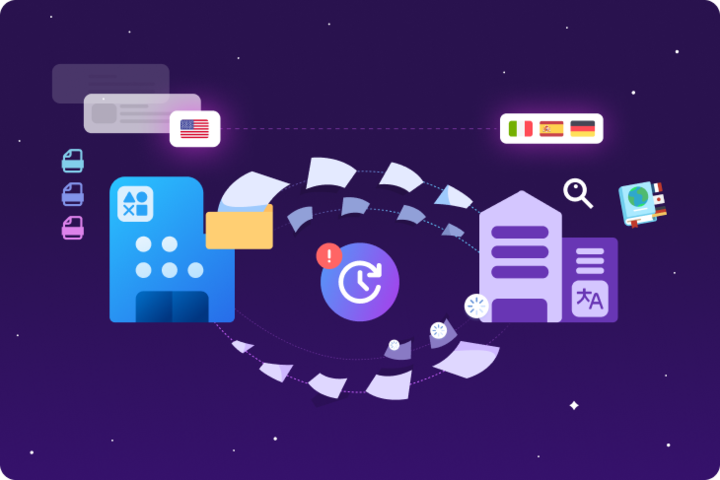
Multilingual content management goes beyond simply translating words from one language to another. It’s the entire system for creating, storing, updating, and publishing content across multiple languages at scale.
Think of it as building a global content ecosystem rather than just translating individual pieces. When you’re updating your product every couple of weeks, having a robust multilingual content management approach isn’t just nice to have. It’s essential.
In practical terms, with multilingual content management:
- “Done” isn’t when your English content is ready, it’s when all language versions are ready and approved. This shifts the definition of completion for any feature or update.
- Content follows a clear path through development, testing, and staging environments before production, ensuring translations stay in sync throughout the entire development pipeline.
- Changes in the source language trigger appropriate updates in all target languages, with clear tracking of what needs to be updated and what’s already been handled.
- Consistency is maintained across your entire multilingual content library, from terminology to formatting to brand voice, regardless of language.
Multilingual content management’s role in software localization
Software localization is the comprehensive process of adapting your product for different markets. It covers everything from translation to cultural adaptation, UI adjustments, and regional formatting changes.
Within this process, multilingual content management serves as the critical infrastructure that makes effective localization possible. It’s the systematic approach to handling your content across languages that ensures your localization efforts run smoothly and efficiently.
Think of it this way: successful software localization requires solid multilingual content management as its foundation. Without proper content management systems, even the best translation quality will get lost in an unmanageable workflow.
The building blocks of effective multilingual content management
Internationalization and multilingual content delivery
Internationalization lays the groundwork for successful software localization by making your product adaptable to different languages and regions. But preparing your software is only half the battle, you also need an efficient system to deliver the right content once it’s translated.
Many teams still manage translation files manually, exporting and reimporting them between systems. This approach becomes a bottleneck as your product and language needs grow.
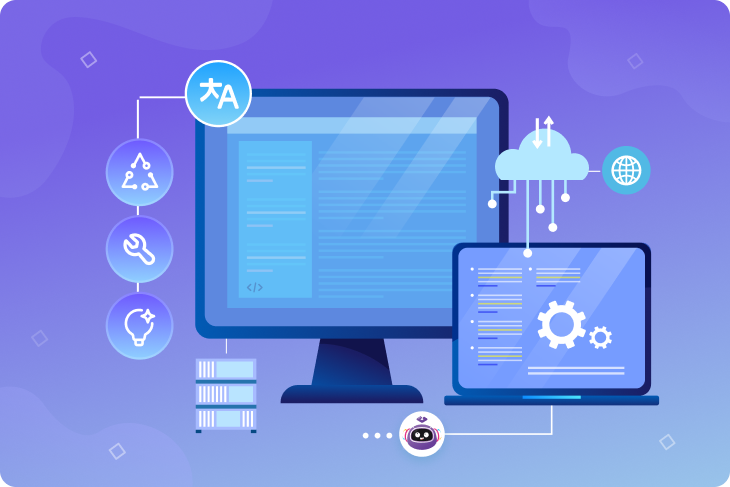
Modern multilingual content management creates a structured content model with clear relationships between content pieces. Content moves seamlessly through APIs, becoming integrated with your build pipeline, no manual file handling required.
With a well-designed content structure you can deliver the right content in the right format to various environments programmatically and separate content from code while maintaining control over updates. This flexibility gives you the control you need without sacrificing automation.
Gridly was built specifically for this type of structured content management, enabling automated content delivery directly to your builds without manual file handling.
» Learn more about the basics of Grids in Gridly.
Tracking changes in volatile multilingual projects
In fast-moving development environments, content changes constantly. When your source language updates, translations quickly fall out of sync without a proper system to track what’s changed.
The traditional approach of manually comparing files or tracking changes in spreadsheets becomes unmanageable as projects grow. You end up with missing updates or unnecessary retranslation because there’s no clear record of what’s new or modified.
A proper multilingual content management system gives you:
- Visibility into exactly what’s changed in the source content, highlighting specific text differences.
- Difference checking to see precisely what needs updating, allowing translators to focus only on actual changes.
- Status tracking across all languages.
Gridly handles this aspect through its Dependencies containing all the changes made, these features provide the much needed flexibility and assurance in volatile localization projects.
Content governance and access control for multilingual teams
Managing multilingual content across global teams presents unique governance challenges. Without proper controls, you risk unauthorized changes, inconsistent updates, and security issues that can derail your localization efforts.
Traditional approaches often rely on spreadsheet sharing or folder permissions that aren’t granular enough for complex localization workflows. This leads to confusion about who can edit what, and often results in content getting changed without proper oversight or documentation.
Digital products often involve many contributors working across different roles and regions. Your multilingual content management solution needs to account for this by:
- Limiting who can edit source content to prevent unauthorized changes that could trigger unnecessary translation updates.
- Controlling what translators can see and modify, so they focus only on relevant content.
- Protecting sensitive content from unauthorized access and leaks, especially important for products with confidential intellectual property.
- Preventing accidental overwrites during imports by maintaining clear version control.
Translation memory & multilingual content reuse strategies
One of the fastest ways to save time and money is by reusing existing translations. While translation memory is traditionally a Translation Management System feature, having it integrated into your multilingual content management workflow creates significant advantages.
When you translate content once, that translation should become an asset you can leverage repeatedly. Without proper translation memory, you end up paying for the same translations multiple times and introducing inconsistencies as different translators handle the same text differently.
Effective multilingual content management incorporates translation memory directly into the content workflow. This allows you to leverage past translations, avoid duplicating translation efforts, and ensure consistency across products and releases. The rule is simple: translate once, reuse many times. This approach stretches your localization budget further while simultaneously improving consistency across your global content.
Gridly’s Translation Memory works seamlessly within your content management environment. Import your previous translations into Gridly’s translation memory. When new content matches or closely resembles previously translated text, the system suggests those existing translations. This works not just for exact matches, but also for fuzzy matches where the content is similar but not identical.
Gridly also offers Working Translation Memory, which captures and suggests translations that are still in progress within the current project. Later on, you can select which entries should be added to your production translation memory. This is particularly valuable as it allows translators to maintain consistency and efficiency without compromising the integrity of the main translation memory.
Integrating multilingual content management with development pipeline
Effective multilingual content management systems need to work seamlessly with your existing tools and processes. Otherwise, localization becomes a bottleneck that slows down your entire development cycle.
The traditional approach of manually exporting and importing localization files creates unnecessary friction. Content gets stuck in transit between systems, developers waste time on file conversions, and errors creep in during the manual handling process.
Effective integration means your content flows automatically between systems without constant human intervention. This eliminates handoff delays and reduces errors while allowing each team to work in their preferred environment.
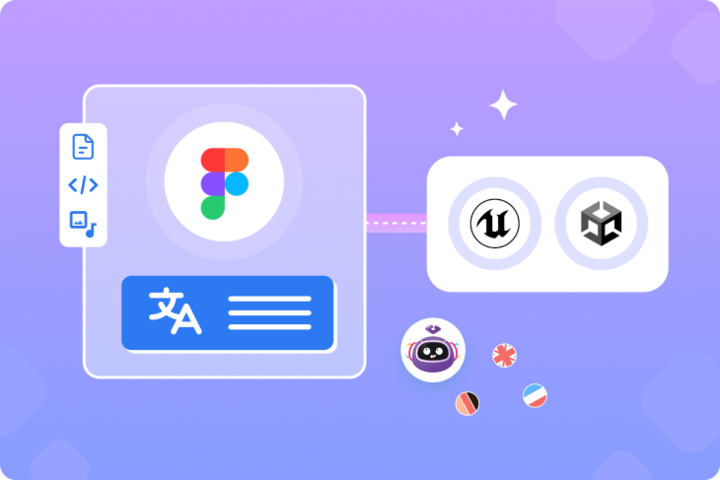
Gridly addresses this challenge through a comprehensive set of integrations designed for modern development workflows:
- GitHub integrations for version control alongside code
- Unreal Engine plugin and Unity plugin for game developers
- Figma integration for designers to sync translations directly into their design files
- Support for various file formats to ensure content moves smoothly between systems
Explore all Gridly’s add-ons and integrations.
These integrations transform multilingual content management from a separate process into a seamless part of your development pipeline, ensuring that your content stays in sync with your product at every stage of development.
Maintaining multilingual content quality and consistency
Every company has domain-specific terminology and content standards that need to be maintained across all languages. When these standards slip, it doesn’t just affect how your product looks—it impacts how users understand and interact with it.
Traditional localization quality checks often happen too late in the process, after content has already been integrated into the product. This means errors are costly to fix and often make it into production, creating a poor experience for international users.
Proactive quality assurance built directly into your content management workflow helps catch issues early when they’re still easy to fix. It also provides translators with immediate feedback, helping them improve quality over time.
Gridly offers robust quality assurance tools. QA Check provides deeper language-specific checks including punctuation errors, mixed encoding issues, and terminology validation against approved glossaries across all target languages.
These automated quality checks significantly reduce the time needed for manual reviews while ensuring consistent terminology and formatting across all your languages. By catching issues early in the content creation process, you can deliver higher quality localized experiences to your global users while keeping your localization timeline on track.
Frequently asked questions
What is multilingual content management?
Multilingual content management is the end-to-end system for creating, storing, updating, and publishing content across multiple languages at scale. It goes well beyond translation — it encompasses the content architecture that makes localization possible, the workflows that keep all language versions in sync with a constantly evolving source, the governance rules that control who can edit what, and the integrations that connect content to development pipelines and distribution systems. For digital products that update frequently, multilingual content management is the infrastructure that determines whether localization is a competitive advantage or a persistent bottleneck.
How is multilingual content management different from translation?
Translation converts text from one language to another. Multilingual content management is the system that makes translation operational at scale across a living product. In practical terms, it means that “done” is not when the English content is ready — it is when all language versions are approved and in sync. It means content changes in the source language automatically trigger update workflows in target languages. It means translators work within access controls that prevent unauthorized edits, and it means completed translations are delivered programmatically to builds and environments without manual file handling. Translation is one step inside that system, not the system itself.
Why do dynamic digital products need a different approach to multilingual content management than static documents?
Static documents — brochures, PDFs, printed materials — rarely change after localization is complete. Managing them multilingually is primarily a storage and organization challenge. Dynamic digital products — apps, SaaS platforms, websites, games — update continuously, sometimes every few weeks. When source content changes, every language version that depends on it needs to be identified, flagged, retranslated or updated, reviewed, and redeployed. Without a system designed to handle this velocity, teams lose track of what has changed, outdated translations reach production, and localization becomes a release blocker rather than a parallel workstream.
What is internationalization and why does it matter for multilingual content management?
Internationalization (often abbreviated as i18n) is the process of designing and building a product so that its content can be adapted to different languages and regions without requiring changes to the core application code. This means separating translatable strings from the codebase, supporting variable text expansion across languages, handling bidirectional text for scripts like Arabic and Hebrew, and accommodating regional formatting for dates, numbers, and currencies. Internationalization is the prerequisite for efficient multilingual content management: without it, every localization update requires developer intervention, which creates bottlenecks and slows down release cycles significantly.
How do teams track content changes across multiple languages without losing control?
Effective change tracking in multilingual projects requires a system that identifies exactly what has changed in source content — not just that a file has been modified, but which specific segments were added, edited, or deleted and what the precise textual difference is. This visibility allows teams to send only changed content for retranslation rather than entire files, prevents unnecessary retranslation of unchanged segments, and gives translators the context they need to understand what has changed and why. Without this granularity, teams either over-translate (wasting budget) or under-translate (shipping outdated content), and both outcomes compound as product update frequency increases.
Why is access control important in multilingual content management?
In a multilingual product, unauthorized or poorly coordinated content changes create cascading problems. A developer editing a source string directly in a shared file can invalidate dozens of existing translations without any record of the change. A translator modifying source content rather than target content can corrupt the reference that all other languages depend on. Without role-based access control, these situations are hard to prevent and harder to audit after the fact. Effective multilingual content management limits source editing to authorized roles, restricts translators to their assigned languages and content scope, protects sensitive content from unauthorized access, and prevents accidental overwrites during imports — all of which are prerequisites for a stable, scalable localization workflow.
How does translation memory integrate with multilingual content management?
Translation memory becomes significantly more powerful when it is embedded directly in the content management workflow rather than operating as a separate CAT tool feature. When translation memory is integrated at the content level, previously approved translations are surfaced automatically the moment matching or similar source content enters the workflow — before a translator even opens a segment. This allows teams to apply exact matches instantly and route fuzzy matches for efficient human review, without requiring translators to manually query a separate database. The result is faster turnaround, lower costs through reduced retranslation, and better consistency because the same source content always maps to the same approved target translation across all projects and releases.
What does it mean to integrate multilingual content management with a development pipeline?
Integration means that content moves automatically between your localization platform and your development environment without manual file exports, imports, or conversions at any step. Source strings extracted from code go directly into the content management system. Completed translations flow back to the build without a developer touching a file. Webhooks or CI/CD integrations trigger localization updates when source content changes are detected, rather than waiting for someone to notice and initiate the process manually. This removes localization as a handoff point in the development cycle and makes it a continuous, parallel process — which is necessary for any team shipping updates on a regular cadence.
How do you maintain terminology and quality consistency across languages at scale?
Consistency at scale requires two complementary layers: a controlled terminology database that defines approved translations for product-specific terms across all target languages, and automated QA checks that validate content against that database and against formatting rules before it reaches human review. Automated checks catch the high-volume, rule-based errors — inconsistent terminology, punctuation violations, mixed encoding issues, missing or malformed placeholders — at the point of submission rather than at the end of a review cycle. Human reviewers can then focus their attention on linguistic quality and cultural appropriateness, which is where their expertise adds the most value. Together, these layers reduce the error rate reaching production and shorten overall review cycles.
What is working translation memory and when should teams use it?
A working translation memory captures translations that are in progress within a current project and makes them available as suggestions to other translators working on the same project simultaneously. This ensures consistency within a project — if one translator has approved a segment, that approved translation is surfaced to the next translator who encounters the same or similar content — without those in-progress translations being promoted to the master translation memory before they have been reviewed and finalized. Working TM is particularly useful for large projects with multiple translators working in parallel, and for AI-generated translation output that needs post-editing review before being stored as a permanent reference.
How does Gridly support multilingual content management for software localization?
Gridly provides a structured content management platform designed around the specific demands of continuous, multilingual software localization. Content is stored in Grids with defined column types, stable IDs, and metadata alongside each translatable segment — creating the structured content model that enables automated content delivery to builds without manual file handling. Dependency tracking flags exactly which translations need updating when source content changes. Role-based access controls govern what each team member can view or edit. Translation memory — including a working TM for in-progress projects — is integrated directly into the content workflow rather than treated as a separate tool. Automated QA checks validate translations against glossaries and formatting rules at submission. And native integrations with GitHub, Unity, Unreal Engine, Figma, and a comprehensive API connect the entire workflow to the development pipeline without manual handoffs at any stage.
Why strong multilingual content management is essential for localization success
The difference between successful global products and those that struggle internationally often comes down to how effectively they manage multilingual content. When localization is treated as an afterthought or managed through outdated processes, it becomes a bottleneck that slows releases and compromises quality.
Companies that invest in proper multilingual content management see measurable improvements across several critical areas. Release cycles shorten dramatically. Team workflows become more efficient. Product experiences become consistent across all languages. And costs decrease through better translation reuse and fewer emergency fixes.
With the right multilingual content management approach, organizations can transform their localization processes from a constant challenge into a competitive advantage. The proper structure, tools, and integrations enable teams to localize faster without sacrificing quality, helping them capture international opportunities before competitors.
Think of it this way: while translation converts your words, proper multilingual content management ensures your entire localization process functions seamlessly from end to end.
Ready to transform your multilingual content management? Schedule a demo today to see how Gridly can work for your specific needs.